
FESINSIDE • HISTORY • CULTURE • TRAVEL
The History of Fes: How Morocco’s Ancient Imperial City Came to Life
From an Idrisid settlement on the banks of the Fes River to a Marinid capital, a center of learning and a UNESCO-listed living medina, the story of Fes is still visible in the streets travelers walk today.
More Than 1,200 Years of Living History
Walk through Fes el-Bali early in the morning and the past does not feel sealed behind museum glass. Bakers slide bread into neighborhood ovens, craftsmen open workshops beneath timbered roofs, water runs through old fountains, and narrow lanes bend around buildings whose origins reach back centuries. In Fes, history is not only something to study. It is part of the city’s daily rhythm.
Fes (also widely spelled Fez) grew from an early Islamic settlement into one of Morocco’s great imperial cities. Across more than twelve centuries, Idrisids, Almoravids, Almohads, Marinids and later dynasties reshaped its streets, institutions and monuments. Scholars, merchants, artisans, migrants and religious communities added further layers. The result is the extraordinary urban landscape visitors encounter today.
UNESCO describes the Medina of Fez as preserving the memory of a capital founded by the Idrisid dynasty between 789 and 808. The organization also highlights the city’s major flourishing under the Marinids in the 13th and 14th centuries and the survival of a remarkably rich historic urban fabric. That long continuity is one reason the Medina of Fez was inscribed on the UNESCO World Heritage List in 1981.
If you are planning a visit, this guide will help you understand not just when Fes changed, but where you can still see those changes today.

Fes History at a Glance
A quick chronology of the turning points that shaped the city travelers see today.
789–808
The Idrisid Foundations
The early city develops as two fortified communities on opposite banks of the Fes River.
11th century
A City United
The Almoravids bring the two urban areas within a single defensive enclosure.
1981
World Heritage Recognition
The Medina of Fez is inscribed on UNESCO’s World Heritage List.
12th–13th centuries
Almohad Expansion
Fes el-Bali grows to roughly the dimensions associated with the historic city today.
1276
Fes Jdid Is Founded
The Marinids establish a new royal and administrative city west of Fes el-Bali.
13th–14th centuries
Marinid High Point
Fes flourishes as a political, intellectual, commercial and architectural center.
1912
A New Political Era
The Treaty of Fez establishes the French Protectorate; the political capital shifts to Rabat.
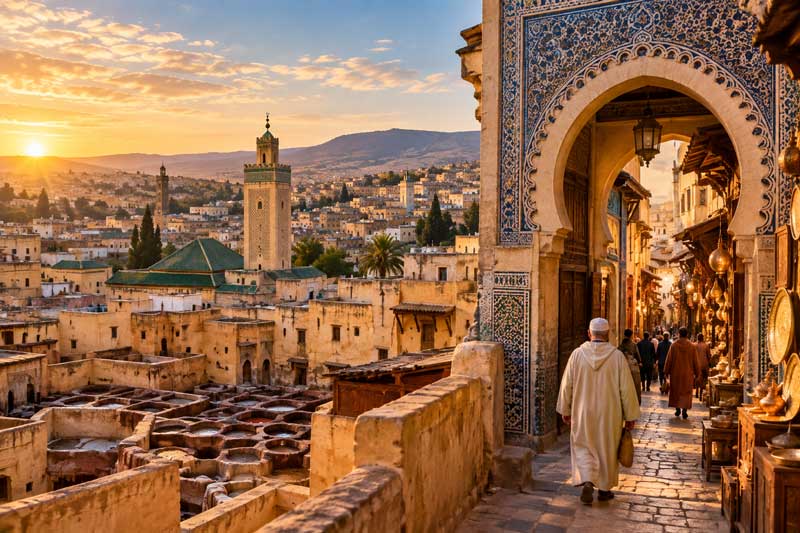
1. The Idrisid Foundations: Where the Story Begins
The beginning of Fes is usually placed in the late eighth and early ninth centuries, during the rise of the Idrisid dynasty. UNESCO’s account dates the foundation of the Idrisid capital to the period between 789 and 808. Rather than beginning as one unified city, early Fes developed as two fortified quarters divided by the Fes River.
Those two banks became associated with different communities: the Andalusian bank and the Kairouan bank. Migration and exchange helped shape the young city, giving Fes connections that extended beyond the surrounding region. Its location also mattered. Water, agricultural land and trade routes supported a settlement that could grow into a major urban center.
This dual origin is important because Fes was diverse from an early stage. The city that later became famous for scholarship, craftsmanship and commerce was formed through movement: people arrived, settled, built institutions and brought knowledge and traditions with them.
2. Al-Qarawiyyin and the Rise of a City of Learning
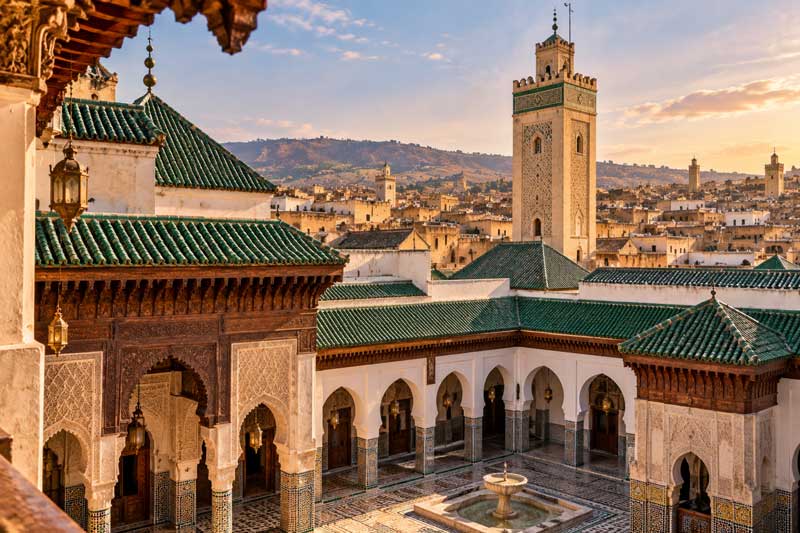
One of the names most closely associated with Fes is al-Qarawiyyin. Founded in the ninth century as a mosque and developing over time into a renowned center of religious and scholarly life, it became central to the intellectual identity of the city. Its presence helped make Fes a destination for students, jurists and scholars from Morocco and the wider Islamic world.
For travelers, the importance of al-Qarawiyyin goes beyond arguments about modern definitions of the word “university.” What matters historically is the extraordinary continuity of learning around the institution and the way scholarship became woven into the reputation of Fes. Religious education, manuscript culture, law and intellectual exchange all contributed to the city’s status as a cultural and spiritual center.
That scholarly legacy still shapes the atmosphere of the old city. Around the Qarawiyyin quarter, the relationship between mosques, madrasas, markets, fountains and workshops shows how learning once sat inside a much larger urban ecosystem rather than in an isolated campus.
3. The Almoravids: Two Settlements Become One City
By the eleventh century, Fes had changed dramatically. UNESCO records that the Almoravids reunited the town within a single rampart. This was more than a change to defensive walls: it helped turn the earlier communities into a more coherent urban whole.
The city’s lanes, commercial areas and neighborhoods continued to evolve within this enclosed fabric. The Medina’s apparent complexity can feel accidental to a first-time visitor, but its form reflects centuries of adaptation to topography, security, climate, trade and neighborhood life.
The Almoravid period therefore marks an important step in the story of Fes: the transition from neighboring early settlements toward the great walled city that later dynasties inherited and transformed.
4. The Almohads and the Growth of Fes el-Bali
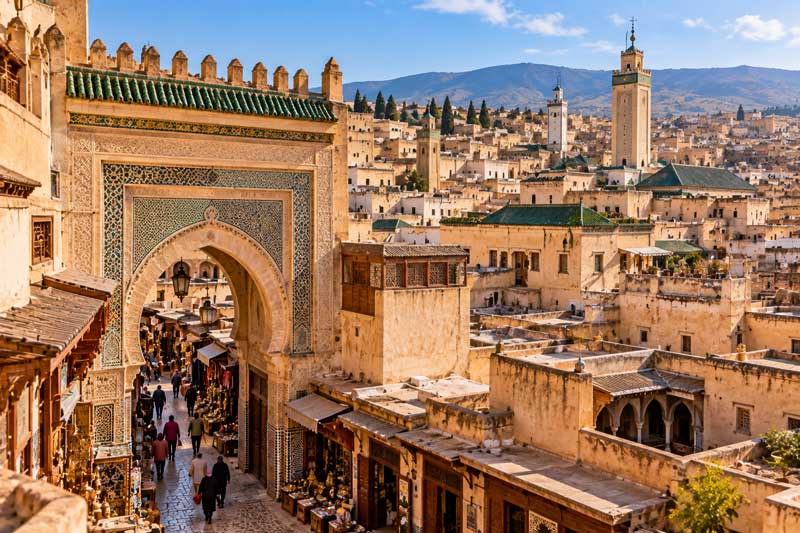
Under the Almohads in the twelfth and thirteenth centuries, the old city expanded further. According to UNESCO, Fes el-Bali had already reached approximately its present-day dimensions during this period.
That fact helps explain why walking through the Medina can feel like entering a complete city rather than a preserved historic district. Fes el-Bali contains residential quarters, commercial streets, religious buildings, workshops, fountains and community institutions packed into a dense urban landscape.
The old Medina was designed for life on foot and for movement through a network of lanes that responds to the terrain. Today, this historic form is part of the experience that makes Fes distinct from newer Moroccan urban districts.
5. The Marinid Golden Age: Fes Becomes an Imperial Capital
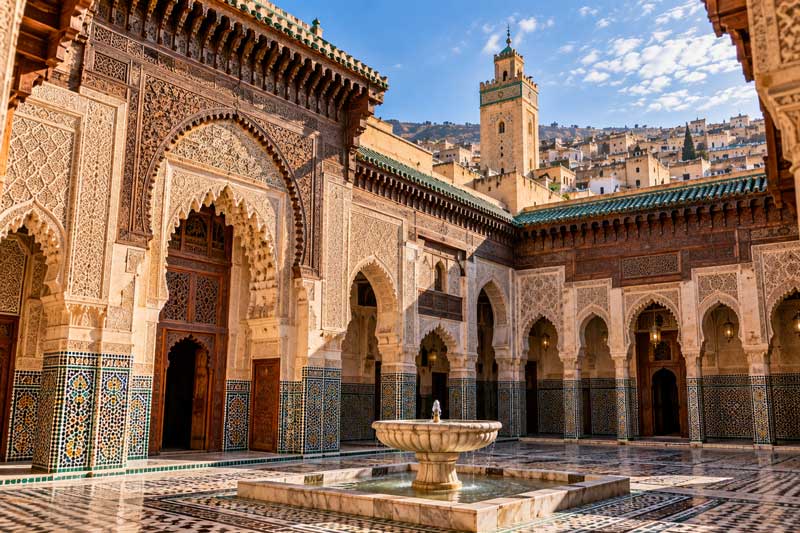
The Marinid era, particularly the thirteenth and fourteenth centuries, is one of the defining chapters in the history of Fes. UNESCO identifies this period as a high point, when Fes replaced Marrakesh as the capital of the kingdom and many of the monuments that characterize the Medina took shape.
The Marinids invested in religious and educational architecture, including madrasas whose carved plaster, cedar, tilework and carefully proportioned courtyards remain among the city’s most admired artistic achievements. Buildings such as the Bou Inania Madrasa allow visitors to experience this architectural language at close range.
This was also a period in which Fes strengthened its role as a center connecting political power, scholarship, trade and craftsmanship. The city’s influence cannot be reduced to palaces or dynasties alone. Its importance depended on the people who taught, traded, produced goods, maintained religious institutions and moved through its markets.
6. 1276: The Founding of Fes Jdid
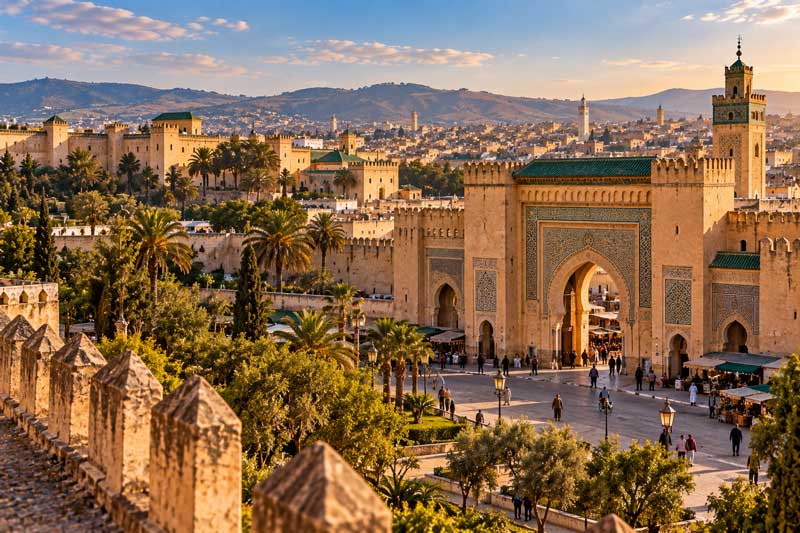
In 1276, the Marinids founded Fes Jdid – literally “New Fes” – to the west of the older city. UNESCO notes that this new urban center contained the royal palace, military functions, fortifications and residential areas.
Fes Jdid did not replace Fes el-Bali. Instead, the two developed side by side, creating a city with distinct but connected historical layers. This distinction remains useful for visitors today: Fes el-Bali is the ancient Medina most travelers imagine when they think of Fes, while Fes Jdid is associated with later royal and administrative development.
Seeing both areas helps make the history of Fes easier to understand physically. The city’s timeline is not abstract; different periods occupy different parts of the urban landscape.
7. The Mellah and the Jewish History of Fes
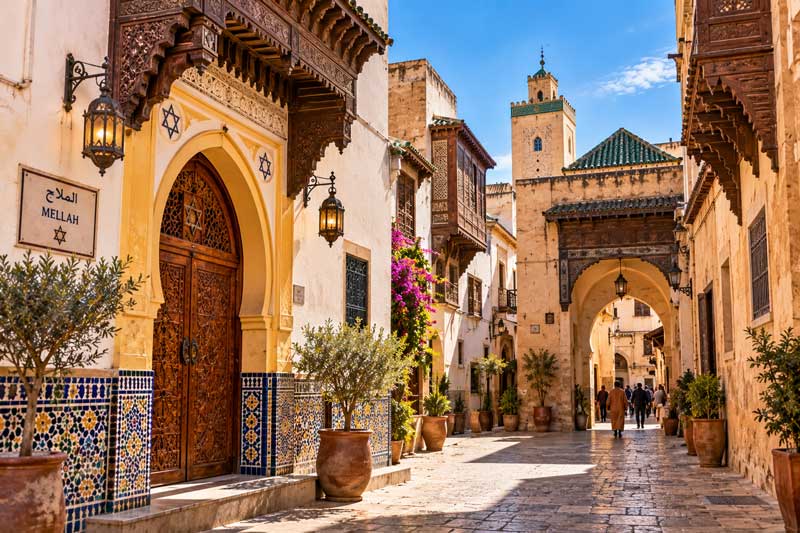
The history of Fes also includes a long and important Jewish presence. In Fes Jdid, the Mellah became the historic Jewish quarter. Its streets, houses, cemetery and synagogues form part of the city’s layered social history.
The story of Jewish Fes is complex and stretches across many centuries, with periods of cultural exchange, prosperity, restriction and hardship. It should not be treated as a decorative footnote to a Medina itinerary. Jewish communities contributed to the commercial, cultural and social life of Morocco, and their history is essential to understanding Fes as a city shaped by multiple communities.
For visitors, exploring the Mellah alongside Fes el-Bali provides a broader view of the city and prevents the history of Fes from being reduced to a single dynasty or religious tradition.
8. Crafts, Commerce and the Working Medina
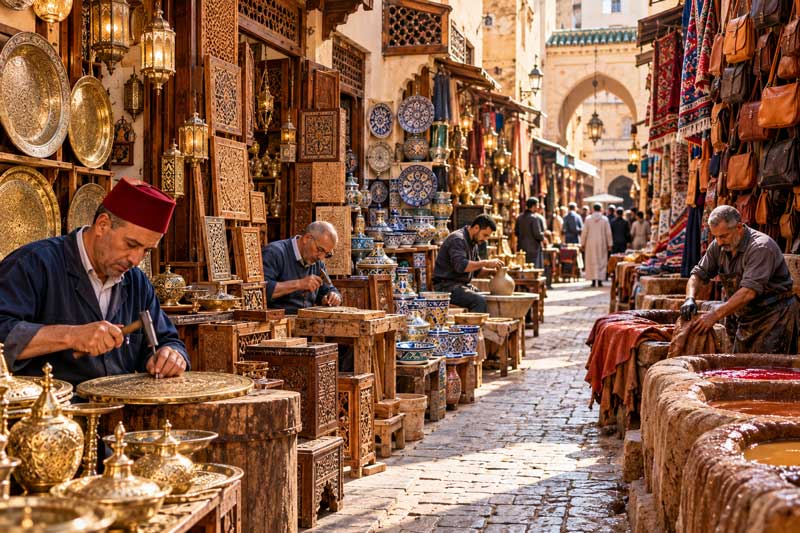
Fes became famous not only for rulers and scholars but also for things made by hand. Leatherwork, metalwork, weaving, wood carving, plasterwork, ceramics and zellige became part of an urban economy in which skills were transmitted through workshops and families.
This is one of the most compelling aspects of Fes for modern travelers: many historic crafts are not merely displayed as heritage. They remain part of the working city. In artisan districts, the sound of hammers, looms and tools still mixes with the movement of shoppers and residents.
The continuity is not perfect or frozen in time – materials, markets and working conditions change – but the survival of specialized craft knowledge gives Fes an unusual connection between built heritage and living practice.
If craftsmanship is one of the reasons you are visiting, FesInside’s Fes Shopping Tour & Artisan Medina Experience is designed around meeting artisans and understanding what is made inside the Medina.
9. Fes Under the Saadians and Alaouites
Political importance shifted between Moroccan cities over the centuries. After the Marinid period, later dynasties governed a changing kingdom in which Fes remained important even when it was not always the principal seat of power.
Under the Alaouite dynasty, which has ruled Morocco since the seventeenth century, Fes continued to hold major religious, commercial and cultural significance. Royal connections, scholarly institutions and regional trade helped preserve its status.
This is an important reminder that the history of Fes is not a simple rise-and-fall story. The city repeatedly changed roles while retaining an identity strong enough to survive political shifts.
10. 1912 and the French Protectorate
The year 1912 was another major turning point. The Treaty of Fez established the French Protectorate in Morocco. The political capital was transferred to Rabat, while Fes retained enormous cultural and spiritual importance.
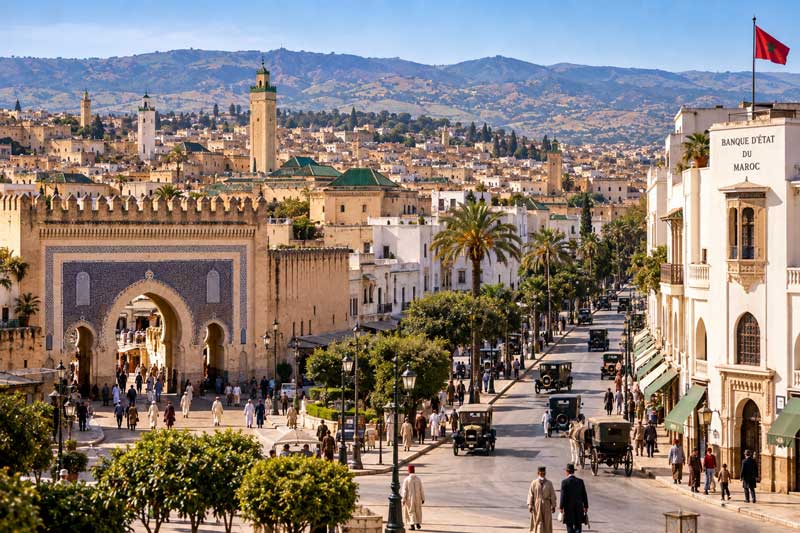
The colonial period also changed the physical structure of Moroccan cities. Newer districts developed outside historic medinas, creating a contrast between the old walled city and modern urban planning. In Fes, this distinction can still be felt between the historic Medina and the Ville Nouvelle.
For the old city, modernization created both opportunities and pressures. Roads, services, changing patterns of residence and new economic systems affected how the Medina functioned, even as its historic urban fabric survived.

11. 1981: The Medina of Fez Becomes a UNESCO World Heritage Site
In 1981, the Medina of Fez was inscribed on UNESCO’s World Heritage List. UNESCO recognizes it as an outstanding example of a medieval town and emphasizes the influence Fes exerted on architecture, monumental arts and town planning across North Africa, Andalusia and parts of Sub-Saharan Africa.
The designation matters because Fes is not simply a collection of famous monuments. Its value also lies in the relationships between streets, houses, markets, religious buildings, workshops and public spaces. UNESCO specifically notes the continuity of functions, skills and culture within the historic city.
Preservation is therefore a living challenge. Protecting Fes means conserving architecture while allowing a real city to continue functioning for residents, craftspeople, businesses and visitors.
12. Where You Can Still See the History of Fes Today
Fes el-Bali: The oldest urban core and the best place to understand the scale and density of the historic city.
Al-Qarawiyyin quarter: A focal point for the scholarly and religious identity that made Fes famous.
Bou Inania Madrasa: A major Marinid monument where architecture, craftsmanship and education meet.
Fes Jdid: The Marinid “new city,” founded in 1276, associated with royal, military and residential functions.
The Mellah: The historic Jewish quarter, essential for understanding the city’s multi-community past.
Traditional souks and artisan quarters: Living spaces where commerce and craft continue within the old urban fabric.
Historic gates, fountains and fondouks: Everyday structures that reveal how movement, water, trade and hospitality worked inside the Medina.
Don’t Just Read the History. Walk Through It.
Discover the stories, hidden corners and centuries-old landmarks of Fes with a local licensed guide.

13. Why Fes Still Feels Different From a Museum City
The most remarkable thing about Fes is continuity. People still live above lanes shaped by medieval urban patterns. Workshops operate near monuments. Markets serve residents as well as visitors. Calls to prayer, deliveries, school runs, shopping and craft production all unfold inside a place recognized internationally for its heritage.
That does not mean the city is unchanged. Fes is a modern Moroccan city facing the same pressures as other historic urban centers: tourism, restoration, housing, infrastructure, commercial change and the need to protect fragile heritage. The Medina’s power comes precisely from the tension between preservation and everyday life.
For travelers, this is why slowing down matters. The history of Fes is easiest to appreciate when you look beyond a checklist of monuments and notice how streets, trades, buildings and communities connect.
A 60-Second Timeline of Fes
Late 8th-early 9th century: Idrisid foundations establish the early city on two banks of the Fes River.
9th century: Al-Qarawiyyin is founded and becomes central to the city’s scholarly identity.
11th century: The Almoravids unite the early urban quarters within one rampart.
12th-13th centuries: Fes el-Bali expands under the Almohads.
1276: The Marinids establish Fes Jdid.
13th-14th centuries: Fes reaches a major political and architectural high point under the Marinids.
17th century onward: Under the Alaouites, Fes remains a major religious, cultural and commercial city.
1912: The French Protectorate begins; Rabat becomes the political capital.
1981: The Medina of Fez is inscribed on the UNESCO World Heritage List.
Frequently Asked Questions About the History of Fes
How old is Fes, Morocco?
The origins of Fes date to the late eighth and early ninth centuries. UNESCO describes the Idrisid capital as having been founded between 789 and 808, giving the city a history of more than 1,200 years.
Who founded Fes?
The foundation of Fes is associated with the Idrisid dynasty, particularly Idris I and Idris II. The early city developed as two fortified settlements on opposite banks of the Fes River.
Why is Fes historically important?
Fes served as an imperial capital, a major center of Islamic scholarship and a hub of trade and craftsmanship. Its Medina also preserves an exceptional concentration of historic architecture and traditional urban life.
What is the difference between Fes el-Bali and Fes Jdid?
Fes el-Bali is the older historic city. Fes Jdid was founded by the Marinids in 1276 to the west and included royal, military and residential functions.
When did Fes become a UNESCO World Heritage Site?
The Medina of Fez was inscribed on UNESCO’s World Heritage List in 1981.
Is Fes still worth visiting if I am not a history expert?
Absolutely. You do not need specialist knowledge to enjoy Fes. Its history is visible through architecture, markets, food, crafts, neighborhoods and everyday life, so even a casual walk can reveal different layers of the city.
EXPERIENCE FES THROUGH ITS HISTORY
Experience the History of Fes, Not Just the Timeline
Fes rewards curiosity. A doorway can lead into a Marinid courtyard. A busy market may follow a commercial pattern shaped centuries ago. A workshop can reveal why craftsmanship became inseparable from the identity of the city. The more context you have, the more the Medina begins to make sense.
If this is your first visit, consider exploring with someone who can connect the visible city to the stories behind it. FesInside offers private, personalized Medina experiences led by a local licensed guide, with the pace and focus adapted to your interests.